Curriculum
At Sunningdale School, every child follows a curriculum designed around their individual strengths, needs, interests and aspirations.
Our pupils have a wide range of learning, communication, interaction, sensory, physical and emotional needs. A single curriculum or teaching approach would therefore not be appropriate for everyone. Instead, we organise our curriculum and provision through four broad pathways:
- Initiate
- Explore
- Functional
- Formal
Each pathway provides a clear starting point for decisions about the curriculum, teaching approaches, learning environment, communication support, sensory provision and assessment most likely to help a pupil learn.
The pathways are not fixed tracks, and they do not place limits on what a child may achieve. Pupils may need elements of more than one pathway, and their provision may change as their strengths, needs and ways of learning develop.
Curriculum Pathways
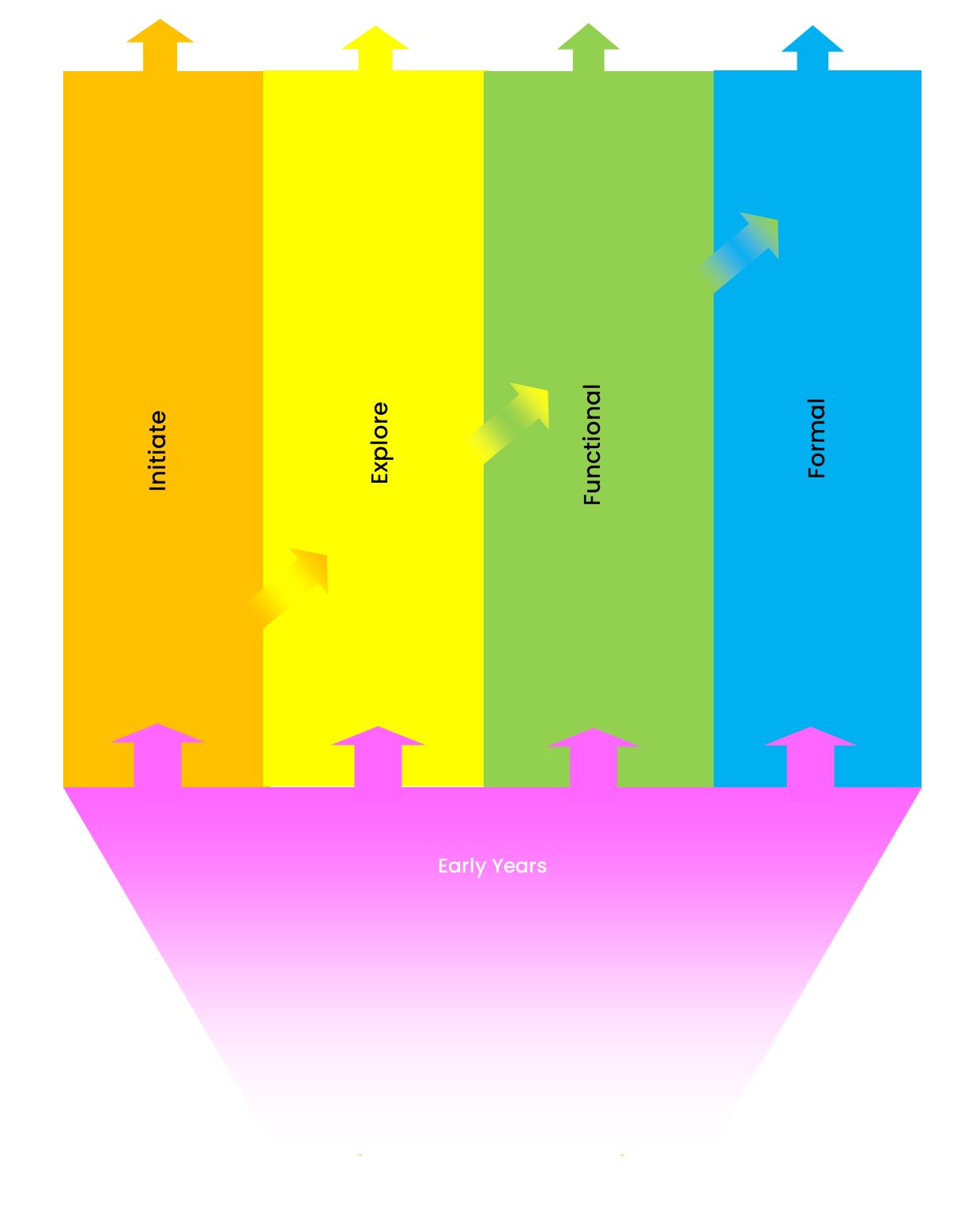
A pathway helps us to establish the broad approach that is likely to work best for a pupil. Within that approach, learning is highly personalised.
Each pupil has a Personalised Learning Plan, linked to the longer-term aspirations and outcomes in their Education, Health and Care Plan. This identifies relevant next steps across areas such as:
- cognition and learning
- communication and interaction
- sensory and physical development
- social, emotional and mental health
- independence and preparation for adulthood
Staff also develop an individual engagement profile for each pupil. This helps us understand how the pupil communicates, what motivates them, what successful engagement looks like and which people, activities, resources and environments help them to learn.
By bringing this information together, we can create the conditions in which each child is most likely to participate, make choices, develop independence and make meaningful progress.
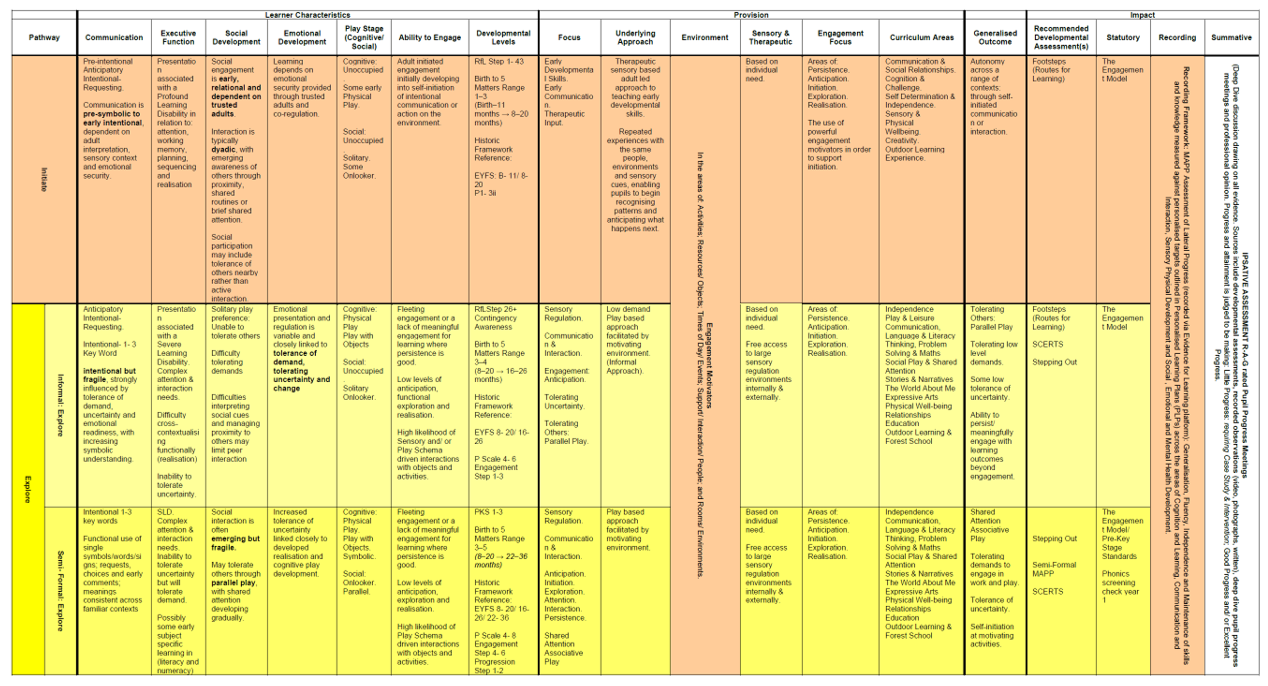
Initiate & Explore Provision Pathway Overview
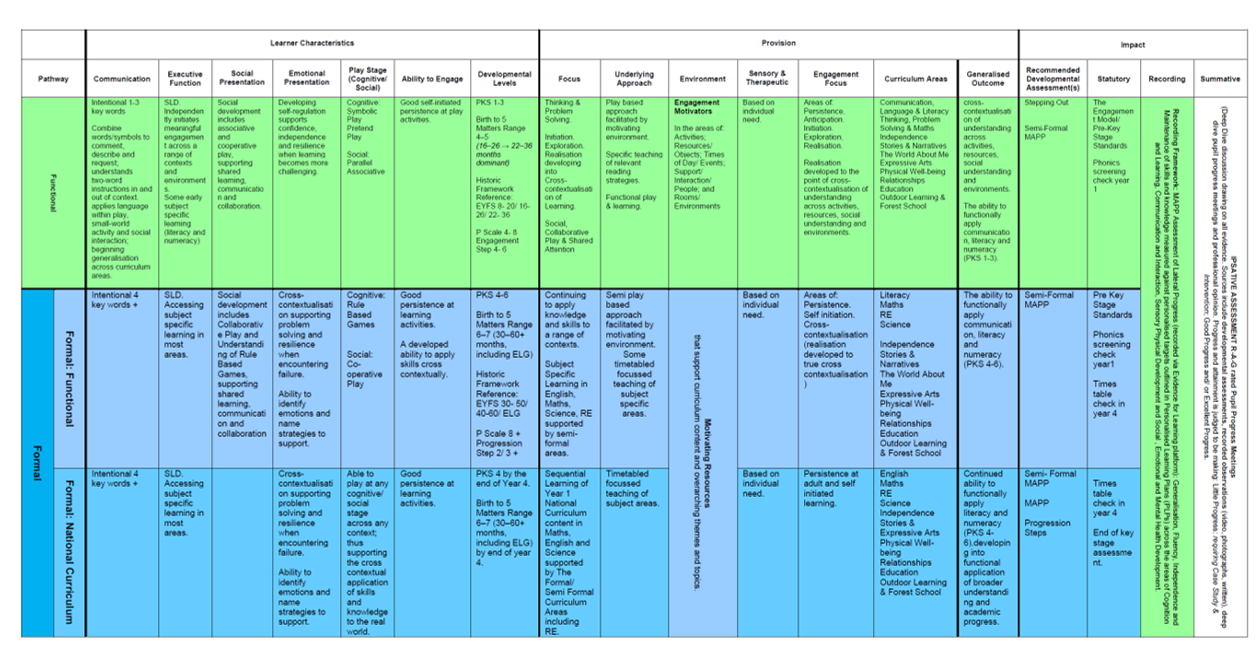
Functional & Formal Provision Pathway Overview
Our Provision Pathways
Initiate Pathway
The Initiate Pathway supports pupils who are at an early stage of development in communication, interaction, cognition and self-directed engagement.
Pupils on this pathway learn most effectively through trusted relationships, consistent routines and meaningful sensory experiences. Their communication may be pre-intentional or emerging, so familiar adults carefully observe and respond to changes in movement, expression, vocalisation, attention and behaviour.
Teaching focuses on helping pupils to:
- become more aware of people, activities and environments
- anticipate familiar experiences
- communicate intentionally
- make choices
- initiate interactions
- develop greater control and autonomy
- participate actively in shared experiences
Learning takes place in highly responsive and predictable environments. Co-regulation, intensive interaction, sensory experiences and appropriate therapeutic approaches are brought together to support each pupil’s engagement, communication and independence.
Explore Pathway
The Explore Pathway supports pupils who are developing their communication, attention, self-regulation and ability to explore and engage with learning.
Pupils may engage very differently depending on how familiar, predictable and emotionally manageable an experience feels. They may initially prefer self-directed or solitary activity and may find demands, uncertainty, changes or interaction with other people difficult.
Provision is therefore designed to be safe, motivating, responsive and appropriately low demand. Play, exploration and sensory regulation are central to the approach.
Teaching focuses on helping pupils to:
- anticipate what will happen next
- initiate communication and activity
- explore objects, people and environments meaningfully
- develop sustained attention and engagement
- manage increasing levels of uncertainty
- participate alongside and with other people
- develop shared attention and early social play
- build greater independence in familiar activities
Some pupils on the Explore Pathway may benefit from a highly informal approach, while others may be ready for more structured semi-formal learning. Provision is adjusted carefully to reflect each pupil’s communication, regulation, interaction and learning needs.
Functional Pathway
The Functional Pathway supports pupils who are developing greater independence in communication, problem-solving and learning.
Pupils on this pathway are increasingly able to engage purposefully, use symbolic communication and learn through imaginative, associative and collaborative play. They are beginning to apply what they know across different activities, environments and social situations.
Teaching focuses on helping pupils to:
- communicate with increasing independence
- solve problems
- apply learning in practical situations
- transfer skills between different contexts
- participate in shared and collaborative learning
- develop functional literacy and numeracy
- strengthen self-regulation, confidence and resilience
- become increasingly independent in everyday life
Learning remains active, motivating and play-based, but includes carefully scaffolded opportunities for pupils to apply their knowledge and skills with increasing independence. Curriculum areas may include communication, literacy, mathematics, independence, understanding the world, expressive arts, physical wellbeing, relationships and outdoor learning.
Formal Pathway
The Formal Pathway supports pupils who are ready to participate in more structured, subject-focused learning.
Pupils on this pathway have developed the communication, engagement and cognitive skills needed to access increasingly formal teaching. They may be working within subject-specific learning, the pre-key stage standards or, where appropriate, relevant content from the National Curriculum.
Teaching may include English, mathematics, science and religious education, alongside continued learning in communication, independence, relationships, physical wellbeing, creativity and preparation for adulthood.
Teaching focuses on helping pupils to:
- develop and apply subject knowledge
- use literacy and numeracy in meaningful situations
- solve problems
- work with increasing independence
- organise and manage their learning
- develop resilience and flexibility
- transfer knowledge and skills between school, home and the wider community
- prepare for the next stage of education and adult life
Pupils continue to receive personalised communication, sensory, therapeutic and emotional support. A more formal curriculum does not mean that these wider areas of development become less important.
Flexible and Hybrid Provision
Children do not always fit neatly within a single pathway.
Where a pupil’s learning characteristics indicate that they would benefit from elements of two or more pathways, we create a flexible or hybrid approach. For example, a pupil may need the communication and sensory provision associated with one pathway while accessing learning from another.
Pathway decisions are based on how a pupil learns and participates, rather than on diagnosis, age or a single assessment score. They are reviewed as part of our ongoing assessment and planning
A number of videos with examples of our curriculum pathways can be found in the News Videos and Curriculum sections of our YouTube channel here.
Play and Engagement
Play is an important part of teaching and learning throughout Sunningdale School.
Through play, children explore the world, communicate ideas, solve problems, develop relationships and connect new experiences with what they already know. Play also gives pupils opportunities to make choices, take the initiative and become active participants in their own learning.
Our play-based approach is adapted to suit different pupils and pathways. It may include:
- sensory and exploratory play
- physical play
- play with objects
- imaginative and symbolic play
- solitary and parallel play
- associative and cooperative play
- structured games and rule-based activities
Adults have an important role in creating motivating environments, noticing and responding to communication, modelling new possibilities and extending learning without taking control away from the child.
Play is central within the Initiate, Explore and Functional Pathways. Pupils on the Formal Pathway also continue to learn through practical activity, play and real-world experiences, alongside more structured subject teaching.
Environments That Enable Learning
A child’s learning is influenced not only by their individual needs but also by the environment around them.
Noise, lighting, space, sensory demands, communication methods, adult support, predictability and the level of challenge can either support participation or create barriers. We therefore consider carefully how environments, teaching strategies and adaptations affect each pupil.
This helps us distinguish between something a pupil is not yet able to do and something they could do if the environment or support were changed. Our aim is to remove unnecessary barriers and create the conditions in which every pupil can participate, communicate and become increasingly independent. We sometimes refer to this as analysing and using the Child’s Engagement Motivators to establish learning environments.

Understanding and Assessing Progress
Progress looks different for every pupil.
For some children, progress may mean understanding a new concept or developing a subject-specific skill. For others, it may mean initiating communication, sustaining attention, making a choice, tolerating a new experience or completing a familiar activity with less support.
We consider both new learning and the different ways in which established learning becomes more secure. This includes:
- independence: completing an activity with less support
- fluency: completing it more confidently or efficiently
- maintenance: retaining the skill over time
- generalisation: applying it in a different activity, environment or situation
Assessment draws on observations, photographs, video, developmental frameworks, Personalised Learning Plan outcomes and professional discussion. This gives us a rich and balanced understanding of each pupil’s progress and helps staff identify the most meaningful next steps.
Find Out More
Examples of learning across our curriculum and provision pathways can be found in the News, Videos and Curriculum sections of our YouTube channel. Our you can check out more detail in the subsections of the curriculum menu of our website at the top of this page.